

Research institutions and technology transfer
Europe has a strong scientific base, but its competitiveness depends not only on research excellence, but also on the ability to translate scientific discoveries into technologies and products that reach the market.
More than 1 100 European universities, public research organisations (PROs) and research hospitals have filed patent applications at the EPO in 2025. These institutions play a vital role in both the European and global innovation ecosystems, yet the challenge of effectively transferring academic knowledge from the lab to the market remains a key policy question.
At the EPO Observatory, we are leveraging new methodologies and the extensive EPO databases to better understand and map the true impact of universities, PROs and research hospitals within the patent system and the European innovation ecosystem.
Our work also examines the European technology transfer ecosystem and the role of Technology Transfer Offices (TTOs) as key intermediaries between public research and the broader economy. TTOs help identify, protect, develop and commercialise research results, while connecting researchers with companies, investors and entrepreneurs to translate scientific discoveries into impactful societal and economic outcomes.
Dive in

Europe’s technology transfer landscape
Discover how European Technology Transfer Offices support the journey from lab to market, and what is needed to strengthen technology transfer across Europe.

The role of European public research in patenting and innovation – study
This study provides an in-depth analysis of the contributions of European public research organisations and research hospitals to patenting activity at the EPO.

The role of European universities in patenting and innovation – study
This study provides the first ever comprehensive overview of the role European universities play in patenting and innovation on a European scale.
Key facts on research institutions, patents and technology transfer
Over 10%
of all European patent applications filed by European applicants with the EPO originated from universities in 2019, up from 6% in 2000.
Almost 63 000
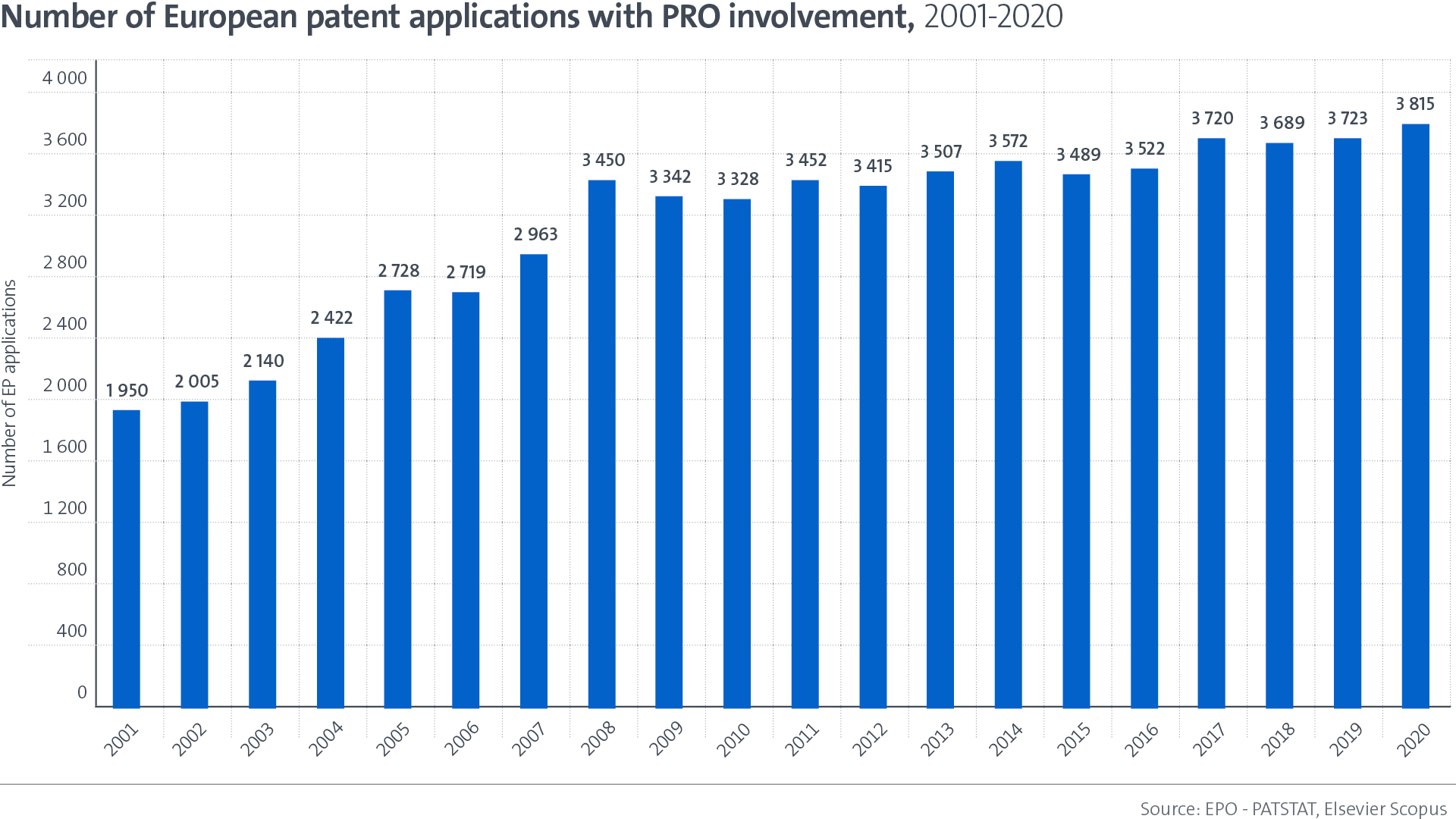
European PROs contributed to almost 63 000 European patent applications between 2001 and 2020, representing roughly 5% of all patent applications where the applicants were European.
A median team of less than seven team members
Most European Technology Transfer Offices are made up of small teams of specialists. The median office employs less than seven full-time equivalent staff members, while half employ between three and fifteen.
Q&A – Insights from the EPO
- How have the patenting activities of universities and public research organisations evolved over time?
European public research organisations such as the CNRS, Fraunhofer, CEA or Max Planck have made a significant impact on patenting activity, contributing nearly 63 000 patent applications to the EPO between 2001 and 2020. These applications, involving PROs either as applicants or through their researchers as inventors, account for 4.9% of all patent applications filed by European applicants during this period.

- What is the overall picture when it comes to universities involved in patenting in Europe, and what are the characteristics of those who are most active?
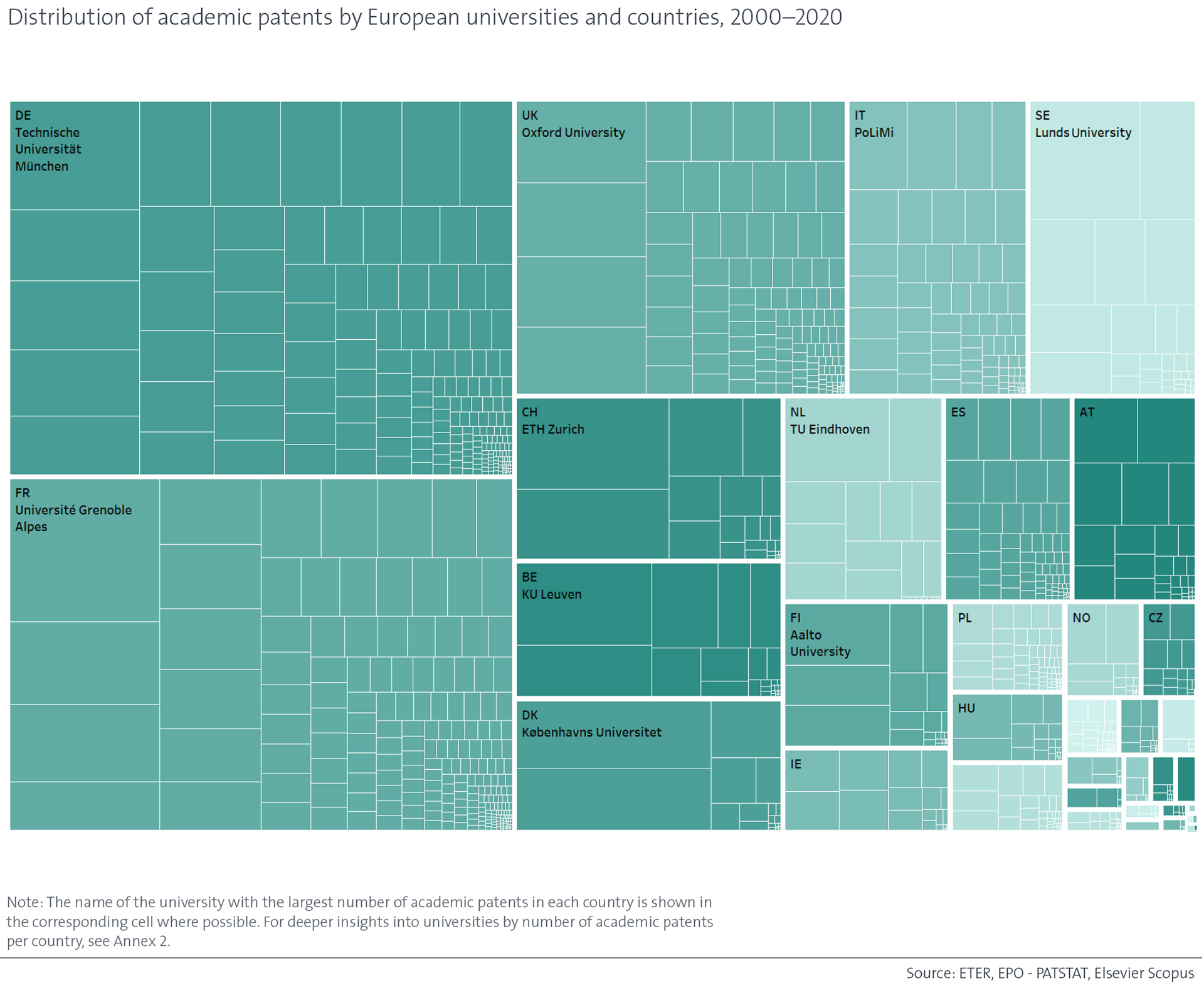
More than 1 200 European universities have filed patent applications at the EPO, and what we are seeing is great diversity among them. Germany and France lead in patent numbers, while smaller countries like Sweden and Switzerland have higher numbers of patents per university. A small percentage (5%) of universities account for half of all patent applications, with over 250 applications filed between 2000 and 2020. These top universities often have strong knowledge transfer offices and file direct patents.
- What approach do universities in different European countries take to their patenting activities?
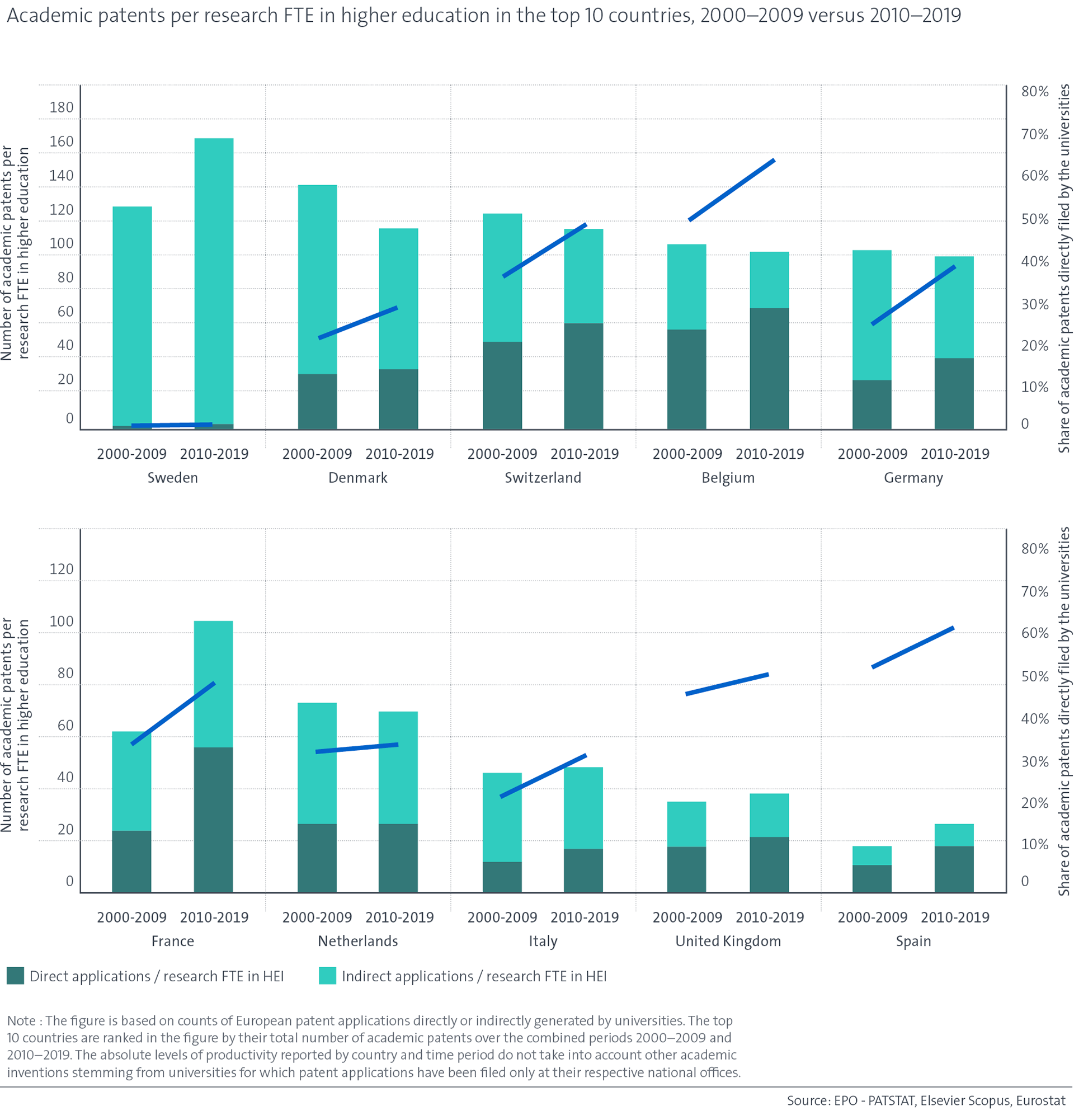
While most countries have seen an increase in direct patent applications by universities, significant differences exist between national models. Nordic countries like Sweden have many academic patents per researcher but fewer university-owned patents. In contrast, countries like France and Belgium see universities filing most academic patents, often in collaboration with public research organisations.
- What role do collaborations play in university patenting?
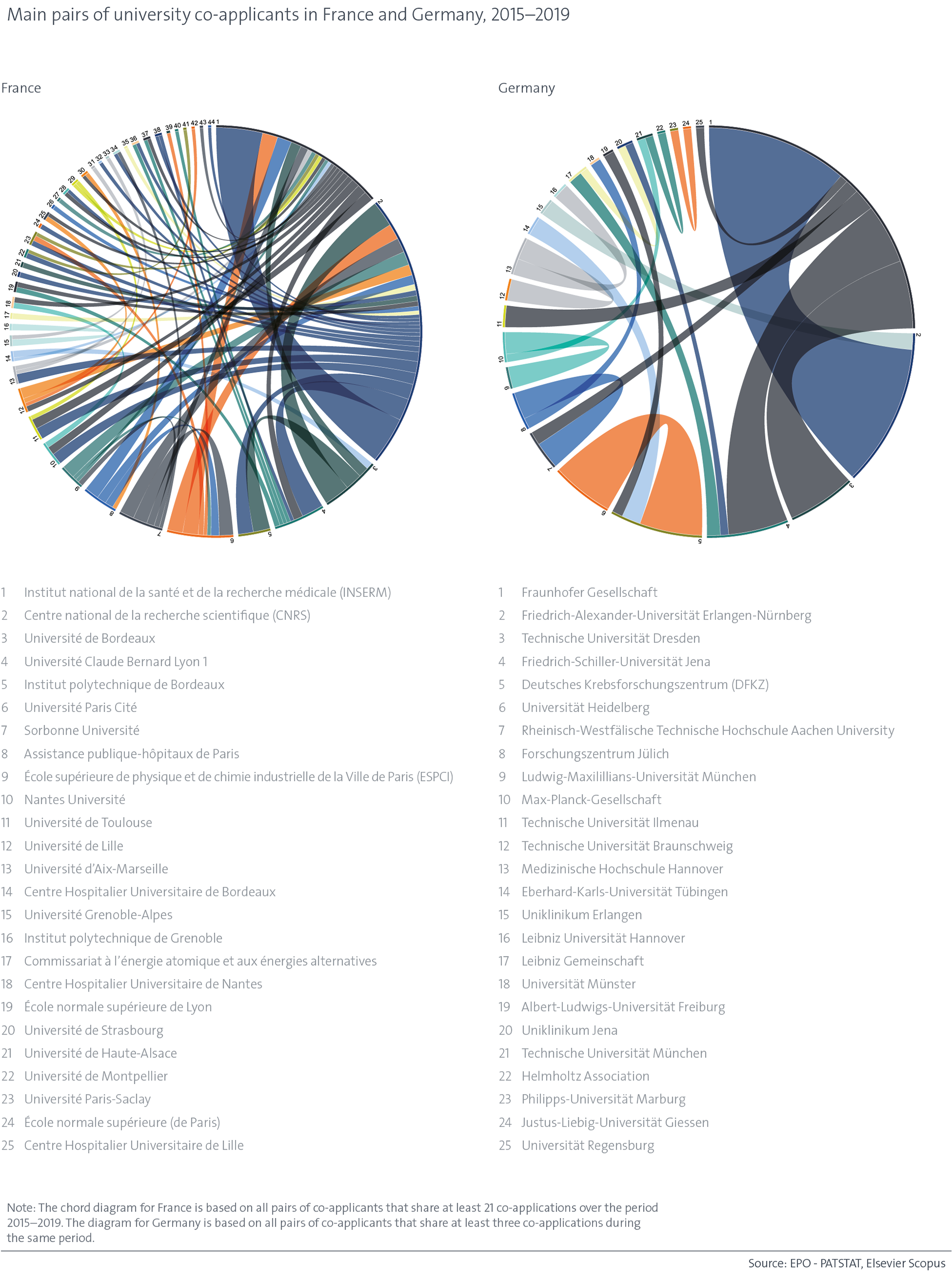
Co-applications, signifying collaboration, are a significant part of university patenting in Europe. France stands out with a high share of co-applications involving public research organisations such as CNRS and INSERM. Similar patterns are seen with the Fraunhofer and Max Planck Institutes in Germany, and other public research organisations in Belgium, Spain and Italy.
- How many deep tech startups in Europe benefit from innovation coming from public research?
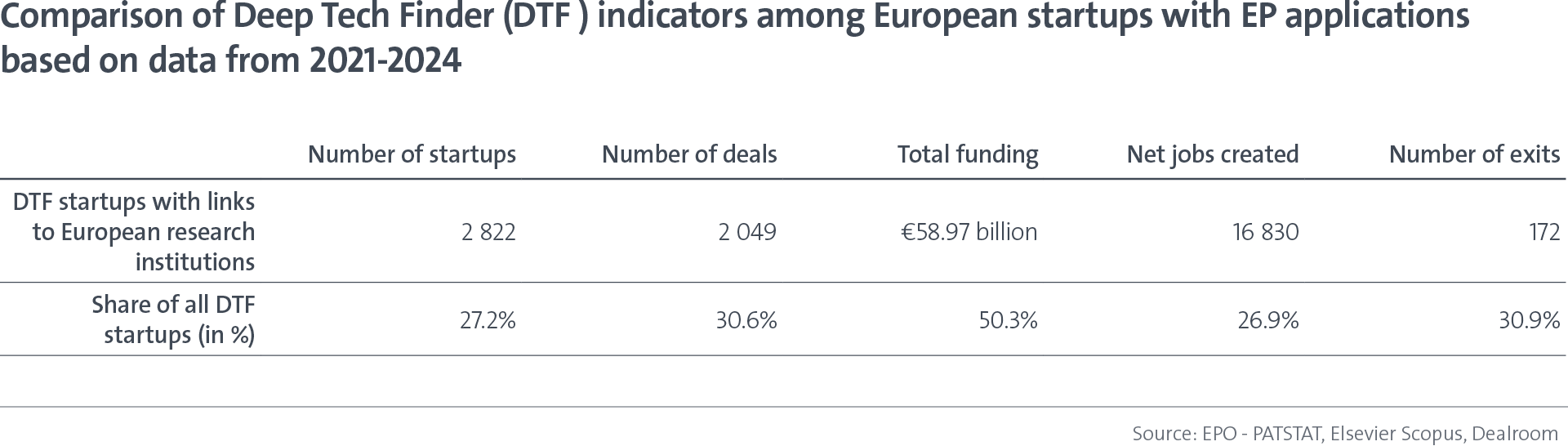
Of all identified startups that have filed at least one European patent application, 27.2% have inventors linked to European research institutions (universities, PROs or research hospitals). This corresponds to over 2 800 European startups.
Despite making up just over a quarter of all identified patenting startups in Europe, these research-linked startups accounted for a far greater share of startup success between 2021 and 2024: 50.3% of total funding raised, 30.6% of all funding deals and 30.9% of all successful exits. This evidence highlights that startup creation has become a critical pathway for bringing European research inventions to market, validating policy efforts aimed at fostering deeper academic engagement in innovation.
- How does the regional context influence university patenting activities?
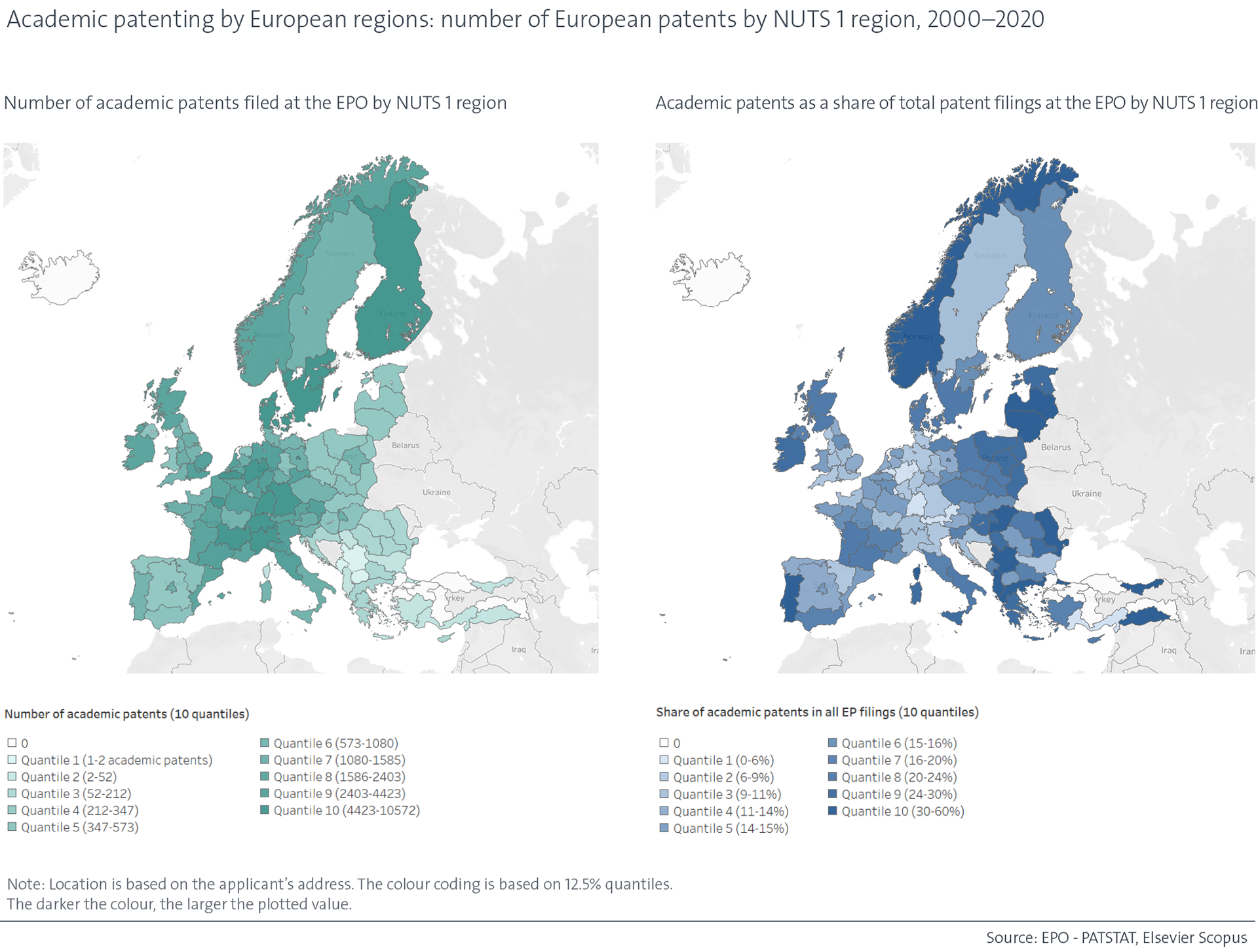
Industrialised regions in Europe produce more academic patents, with ample opportunities for collaboration and tech transfer. In less industrialised regions, particularly in Central and Eastern Europe, universities produce fewer patents but contribute more to innovation at a local level, making them crucial to regional ecosystems.
- What share of patents from universities and public research organisations ends up being commercialised?
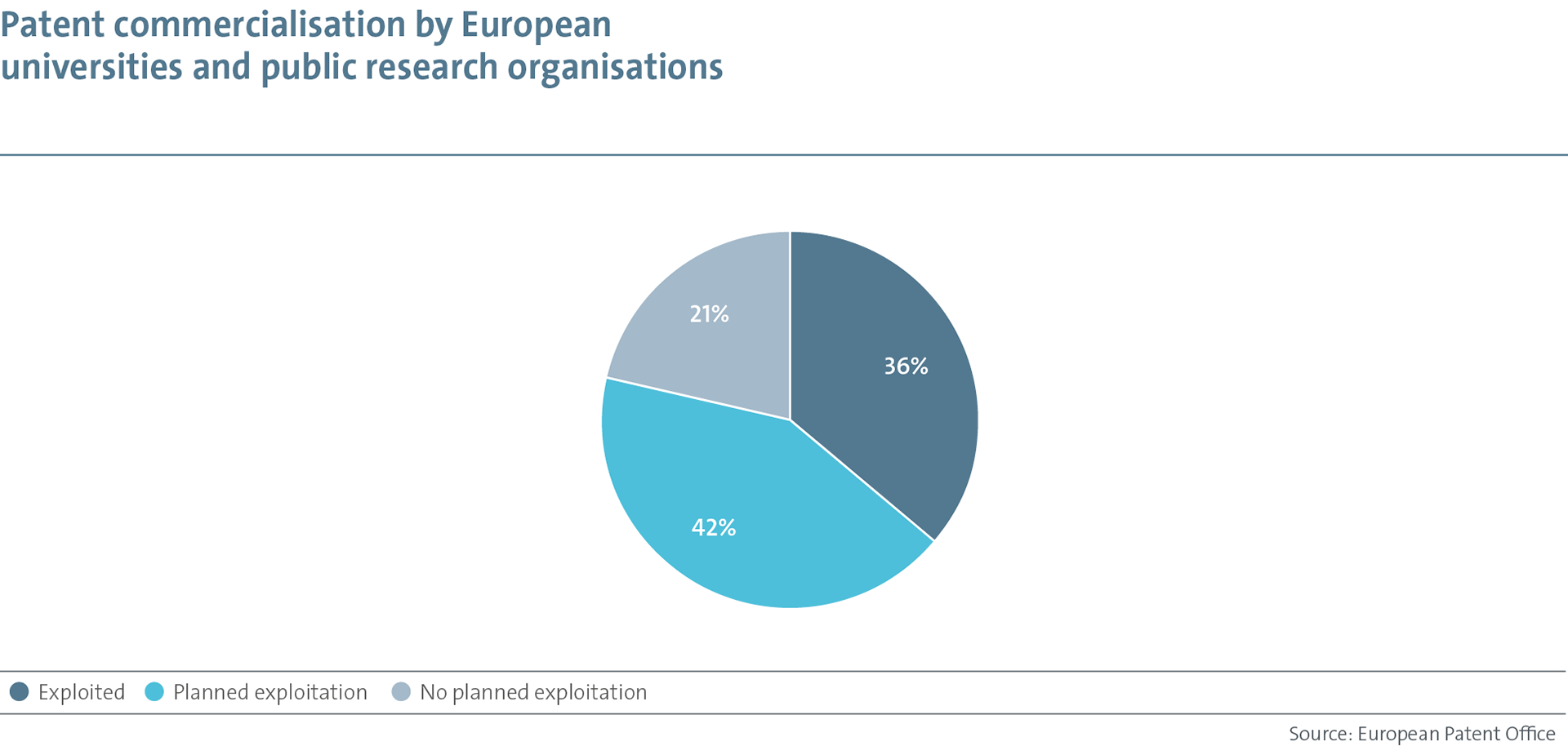
European universities and public research organisations use the European patent system as a key pathway to bring their inventions from the lab to market, enabling international commercialisation, scale-up for manufacturing and the generation of revenue for their institutions. Today, these research bodies already commercialise over one third (36%) of the inventions for which they have filed a patent application with the EPO. Licensing stands out as their preferred commercialisation channel, accounting for 70% of all commercialised inventions, while the creation of spin-off companies is cited as a motivation for 41% of them.
- What role do European research hospitals play in contributing to patenting activity at the EPO?
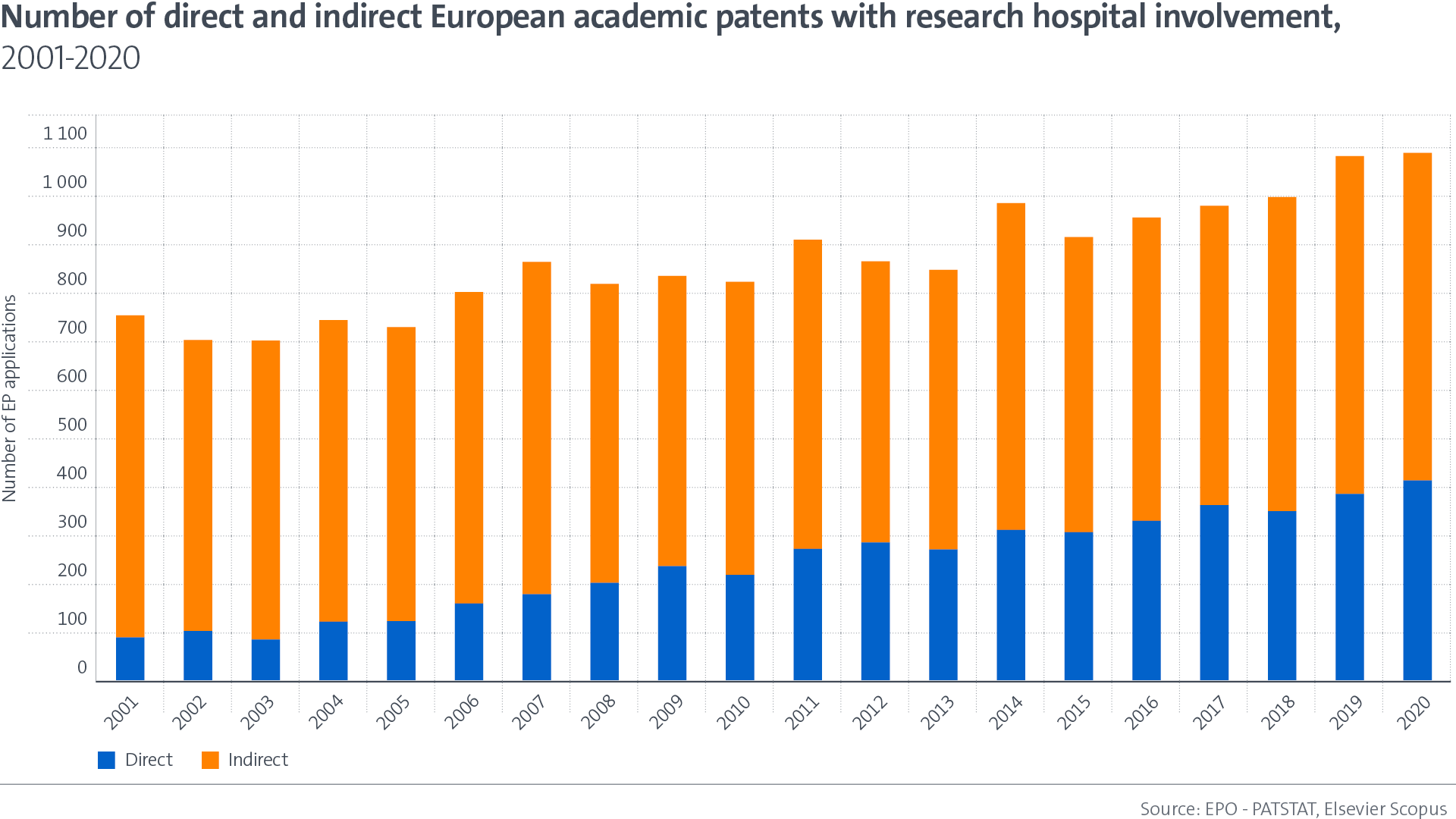
European research hospitals play a key role in medical innovation, contributing 17 434 EP applications between 2001 and 2020. Annual filings grew from around 700 in the early 2000s to nearly 1 100 by 2020. This was driven mainly by the rise from 90 to over 400 in direct applications, where hospitals were the applicants. In contrast, indirect applications, where hospital researchers were inventors but other entities were applicants, remained steady at 600-700 per year.
- What are Technology Transfer Offices and what role do they play?
Technology Transfer Offices support universities, public research organisations and research hospitals in identifying, evaluating, protecting and transferring research results to the market. Depending on their mandate and resources, they may manage IP portfolios, identify commercial partners, negotiate licences and research agreements, facilitate access to proof-of-concept funding, and support the creation of spin-offs and startups.
- What does the European technology transfer landscape look like?
There is no single model for a European TTO. Offices differ significantly in terms of size, staff experience, institutional setting and responsibilities. Most are relatively small, consisting of six to seven full-time equivalent staff members, and receive around nine invention disclosures in a typical year. Of the TTOs reporting an establishment year, more than half were created in 2005 or later.
- Does the size of a Technology Transfer Office affect its results?
Larger TTOs manage much greater research and invention pipelines and can sustain a broader range of specialist capabilities. However, this does not mean that smaller offices are necessarily less effective at progressing individual inventions. Indeed, on most of the study’s measures, no statistically significant differences were found between small and large offices when outcomes were assessed relative to the number of inventions disclosed.
- How can Europe strengthen technology transfer?
The study highlights the need to recognise TTOs as strategic innovation actors that require stable capacity throughout the technology transfer journey and better access to specialist expertise, funding and commercial networks. It also underscores the value of combining close relationships with local researchers with shared capabilities and stronger cross-border connections to companies, investors and entrepreneurs.


Publications
Dive into a collection of economic studies focused on the role of universities and technology influencers.
See all publications related to Research institutions and technology transfer

Discover how European Technology Transfer Offices support the journey from lab to market, and what is needed to strengthen technology transfer across Europe.

This study provides an in-depth analysis of the contributions of European public research organisations and research hospitals to patenting activity at the EPO.

This study provides the first ever comprehensive overview of the role European universities play in patenting and innovation on a European scale.
Innovation case studies
Explore a series of innovation case studies showcasing how universities, public research organisations and their spin-offs, and technology transfer offices have successfully leveraged intellectual property. These real-world examples highlight the role of IP in driving growth, securing funding and fostering innovation.

University-owned patents created the springboard for this spin-off to enter the market for additive manufacturing (3D-printed) ceramics in industrial applications.

This product to treat open wounds, such as diabetic ulcers, is the result of R&D carried out by four women, inventors in the laboratory of Türkiye's Ege University.

A research project to improve surgical navigation combined with the entrepreneurial mindset of the lead researcher at the University of Coimbra in Portugal led to the creation of Perceive3D.
Tools

Find universities, public research organisations and their spinouts in your field
The Deep Tech Finder is your gateway to exploring Europe's innovation landscape. Designed for investors, researchers, startups and universities, this free tool connects you with key players in cutting-edge technology fields.

Dashboard on "Research institutions in collaboration"
The Data Desk features a detailed dashboard capturing the actual contribution of research institutions to the development of inventions, including views by institution, country and region.

Get to know the IPScore of research projects
The EPO's IPscore tool makes it possible to assess, qualitatively analyse, graphically visualise and document the pros and cons of technologies and research projects.
Podcasts

Why keeping your invention secret is crucial
How can you best avoid a blunder made by many inventors? Prematurely disclosing your invention through academic publications is a common mistake. Find out why keeping your invention a secret – using non-disclosure agreements if necessary – is key until you file your patent application to optimise your chances for success.

Science meets startup: public research on the rise
Dr Jérôme Galon, shares his journey as a public researcher and biotech startup founder, reflecting on how researchers have found increasing acceptance and support as they branch into business.
How to use patent knowledge to innovate
As an inventor, micro-entity, startup or university researcher, how do you keep abreast of the latest technology developments? While some believe patents lock away knowledge, keeping it from the public, nothing could be further from the truth. Find out how you can leverage free patent databases to succeed in your line of business.
Events
Explore the events we are hosting and watch the recaps via the recordings.