
EPO President discusses future of global IP system at AIPPI World Congress

EPO President Campinos during his keynote address at the AIPPI World Congress in Hamburg
At the AIPPI World Congress in Hamburg, the President of the European Patent Office (EPO) António Campinos exchanged with IP leaders from around the world on AI, patent quality and the future of the patent system.
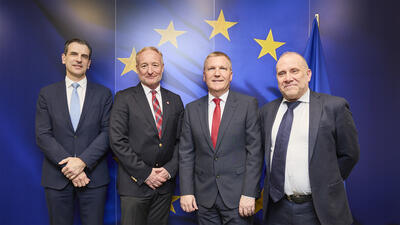
On 7 October 2026, President Campinos participated in a high-level roundtable at the AIPPI World Congress in Hamburg. He was joined by German Patent and Trademark Office President Eva Schewior, Unified Patent Court President Klaus Grabinski, Director of IP, Government Procurement Competition Division at the World Trade Organization Tanuja Garde, and Director of the UPC’s Patent Mediation and Arbitration Centre Ales Zalar.
Moderated by AIPPI Reporter General Ralph Nack and First Deputy Reporter General Guillaume Henry, the discussion focused on how IP institutions are responding to technological, economic and geopolitical change, with particular attention to the implications of artificial intelligence for the patent system.
AI and the future of the patent system
A central theme was the rapid development of AI, including increasingly autonomous or “agentic” AI systems, and what this could mean for a patent system traditionally centred on human creativity and inventiveness.
President Campinos underlined that, while AI raises important new questions, the foundations of the European patent system remain robust. The European Patent Convention and its application have adapted to more than 50 years of technological change while retaining the core concepts of technical character, novelty, inventive step and industrial applicability. AI, he said, represents a “stress test” for the patent system rather than a reason to redesign it.
He also pointed to emerging questions around inventorship, inventive step, disclosure and AI-generated prior art, saying that the response should be evolutionary: monitoring developments closely and refining the application of existing principles where necessary, while preserving legal certainty.
Quality, timeliness and user confidence
President Campinos emphasised that quality and timeliness are not competing objectives but must reinforce one another. A high-quality patent system must deliver robust, legally sound decisions within a timeframe that supports inventors and investment.
He highlighted the progress made in timeliness at the EPO, with standard search reports now delivered in less than six months and the average time from filing to grant now at 36.3 months, well within the EPO’s 48-month target.
AI is increasingly used across the patent -granting process, including for classification, search, machine translation and legal queries. President Campinos stressed that AI supports rather than replaces examiners: human expertise and responsibility for substantive decisions remain central.
Making the system more coherent and predictable for users is also a key priority for the EPO. The roundtable highlighted the complementary roles of national and European patent routes, with closer co-operation through shared IT tools, training and convergence initiatives helping to deliver simpler, more harmonised processes and trusted solutions for users across Europe.
EPO and AIPPI
AIPPI, the International Association for the Protection of Intellectual Property, is an international non-profit association dedicated to the development and harmonisation of intellectual property law. It has more than 8 000 members in over 110 countries, including patent attorneys, lawyers, judges, academics and corporate IP professionals.
The EPO and AIPPI maintain a longstanding dialogue on issues including patent quality, digitalisation and AI, the Unitary Patent, patent law harmonisation and developments in the European and international patent systems.